The Project Site
-
The site is Showa-era shophouse built in 1965 with an extension built in the 1980s. The shop was used as a hairdressing salon for 4 decades, and has been abandoned for 20 years.
The space can be occupied solo or shared with up to 9 people.
The original 1960s shophouse is used for the Untitled (Occupied House) program. This building has a shop area that faces the street, and originally had 4 additional tatami rooms and a toilet.
The 80s extension houses a caretaker's residence which has a kitchen, bathroom and 3 western-style bedrooms. Participants in the Untitled project currently share the caretaker’s kitchen & bathroom while we raise funds to build wheelchair-accessible facilities.
You're welcome to give us a call before you apply, or visit the site if you're in Japan.
-
Currently the space is not wheelchair accessible.
However all the facilities and one sleeping area are located on the ground floor.
There is one step between the main hallway and other areas. The sleeping area, kitchen and toilet are all on the same level.
Access ways, including to the toilet, are a minimum of 800mm wide.
-
TYPE: Clean working/ sleeping areas
FLOORING: Tatami mats
ACCESS: Not suitable for people with limited mobility, second floor with steep staircase, 800m wide
LIGHTING: Good natural light in street facing rooms, standard room lighting
FACILITIES/ EQUIPMENT: Electric heating, kotatsu table (heated) available, double futon or 2 x single futons + bedding available in each room
SIZE: Overall space is 6.2m x 8.9m, divided by sliding screens
Upstairs middle room: 4.4 x 4.4m, 12 tatami mat/ sleeps 3-4
South-facing rooms: The original rooms have been combined to make a large 6.1m x 3.5m room with work space and kotatsu table, remaining 6 tatami mat area sleeps 2
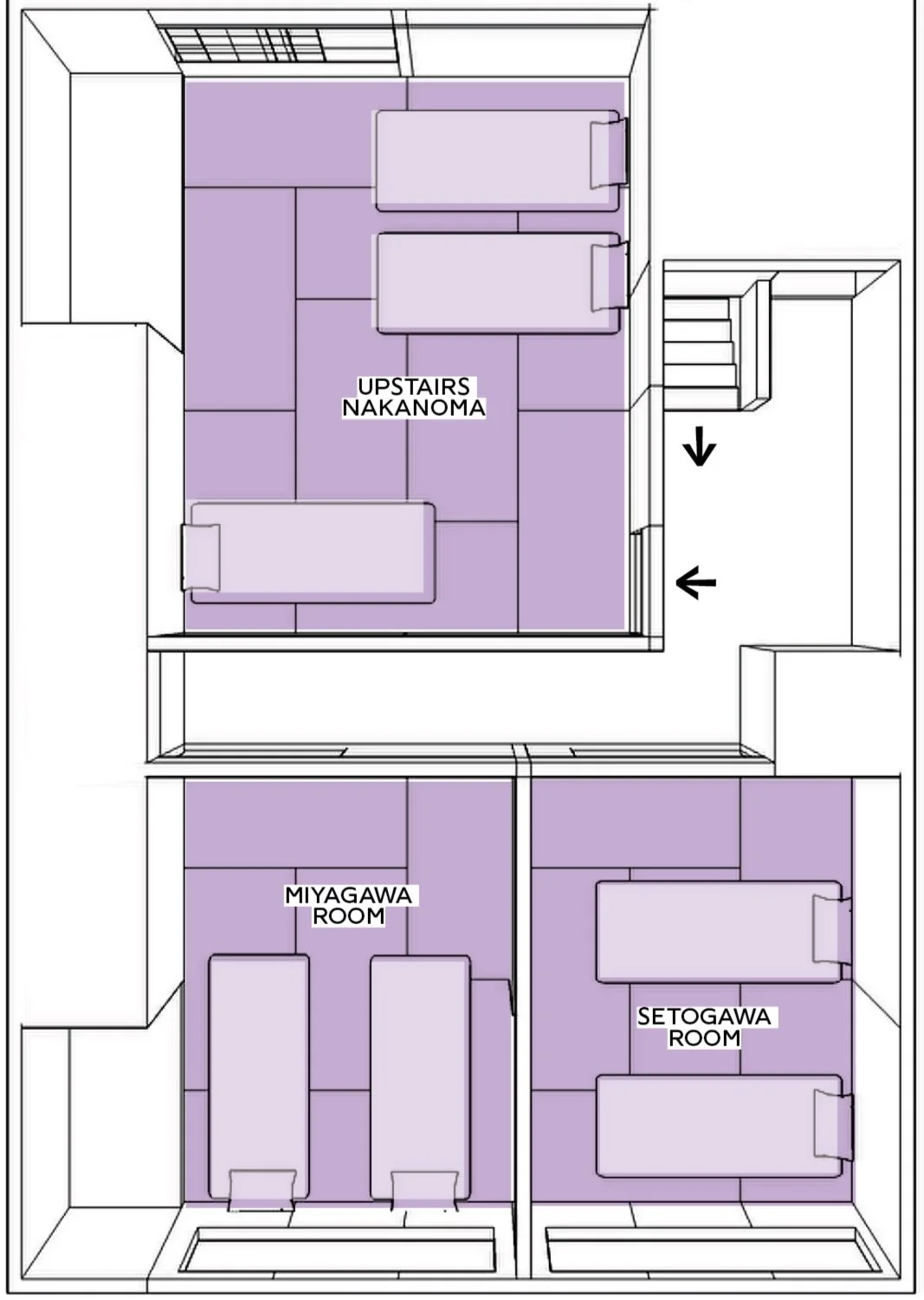
The two small south facing rooms (Miyagawa and Setogawa) have been combined to form one large room, the Miyagawa side still has tatami, the other side now has timber floor boards and work spaces for studio use.
-
The following spaces are shared with the caretaker & Hida Social Club members. Bookings for exclusive use should be made in advance.
-
Occupants are allowed full use of the caretakers kitchen & bathroom. Facilities are simple. Catering or groceries can be provided.
Stove with fish grill
Air dryer (oven replacement)
Sink
Fridge
Dining area (seats 4-5, can be extended to seat 10
-
TYPE: Wet working area
FLOORING: Sheet vinyl flooring
ACCESS: Ambulant, ground floor, one step, 900m doorway
LIGHTING: Good natural light, standard room lighting
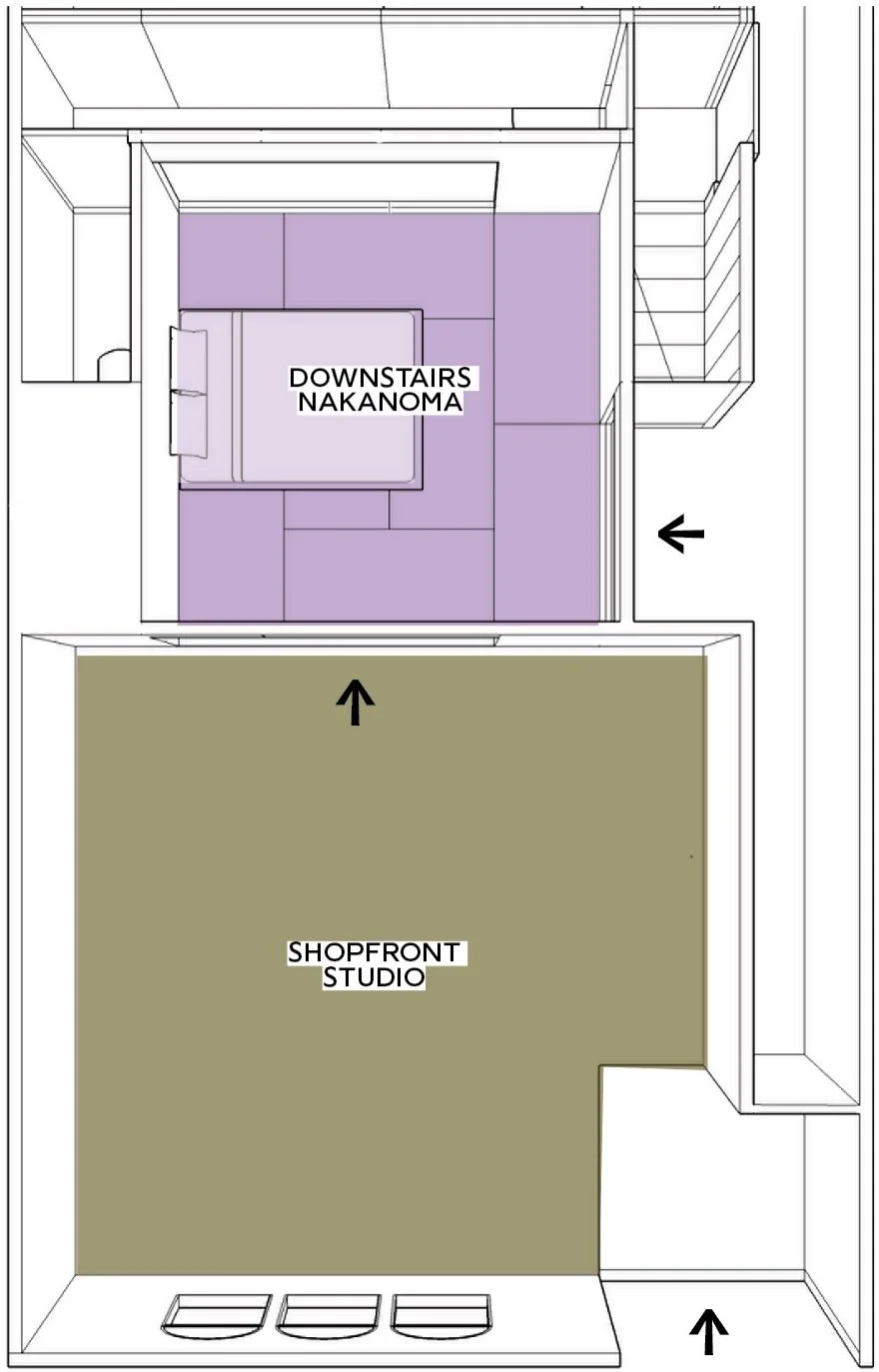
FACILITIES/ EQUIPMENT: Propane heating (not suitable for sleeping), large table, some original shop fittings in place
SIZE: 5.2m x 3.5m
-
Use of the downstairs tatami room can be arranged for occupants who can’t access the upstairs area comfortably.
-
Downstairs Middle Room
TYPE: Clean working area/ sleeping
FLOORING: Tatami mats
ACCESS: Ambulant, ground floor, one step, 100m doorway
LIGHTING: Some natural light, standard room lighting
FACILITIES/ EQUIPMENT: Toilet is adjacent. Electric heating, kotatsu table (heated) available, double futon or 2 x single futons + bedding available
SIZE: 3.5m x 3.5m, 8 tatami/ sleeps 2
FAQs
Do I have to stay for the whole season?
No. The space is yours for the defined period of your occupancy. You are the occupant. But you decide what that means.
You might come and stay, but you might decide send someone else to occupy it on your behalf. You might decide to deliberately let it sit empty or stay for a single night. You might share the space with other people or give instructions on how the space is used. You might hold an exhibition or host an activity remotely. How you define what it means to occupy the space is up to you.
Do I have to stay in the house to participate?
No.
Can other people come and stay?
Yes, there is room for 4 people comfortably in the 2 upstairs rooms, using the downstairs accessible room or adding more futons - there is room for up to 9.
You decide everything about how your occupancy works, including on who is physically in the space. We ask you to negotiate anything that will affect future occupants, and of course you must obey local laws - but otherwise how you use the space is up to you.
Can I make physical changes to the property?
Yes.
Can I have the whole space to myself?
The occupancy area includes the self contained second floor above the original shop house (6.15m ×8.75m) which has two large rooms.
Occupants use the caretakers kitchen & bathroom & share these with the caretakers.
There is an additional downstairs tatami room which is available upon request for occupants who need a more easily accessible space.
It is possible to organise for other parties to occupy your space during your occupancy and to receive payment or benefits from this.
Use of the whole house is sometimes possible on request. The caretakers’ residence is in the 1980’s extension at the rear & includes 3 extra bedrooms. Please note there may be additional costs involved.
Do you have a grant program?
Yes, contact us for details.
What should my budget be?
You will need a budget for groceries, personal products, eating out, entertainment & travel. Utilities, towels, bedding, household products, wifi are covered by the fee.
The cost of living in Japan is comparatively low, especially in the countryside. It can be lower than India or Thailand on a day-to-day basis. It is possible to eat out for less than ¥1,000 (US$7) per meal, allow ¥1,500 - ¥2,500 especially if including alcohol.
A budget of ¥4,500 (US$30) per day will cover groceries & sundry costs while allowing eating out occasionally. We have bicycles & the town is walkable, so you don’t really need a transportation budget day-to-day.
Allow additional budget for exploring Japan. Shinkansen and express trains cost more than highway buses. Allow ¥10,000 (US$70), for transpart to places like Kanzawa via Shirakawa-go, Gero Onsen or Nagano and back, and ¥7,000 (US$50) one-way to Tokyo or Osaka via bus , double that for the train. Getting around Hida & Takayama is about ¥500-600 return.
Accommodation in a hostel or local guest house is about ¥4,000 - ¥8,000 a night, a decent hotel is ¥6,000 - ¥26,000 per night, in some areas prices jump significantly during peak season.